Home › Blog › The 4 steps
What does toner do? How to use it every morning

Already know what you need? Order from my RINGANA shop. With the code DIANAMARTINEZ, €20 off your first order of €50 or more.
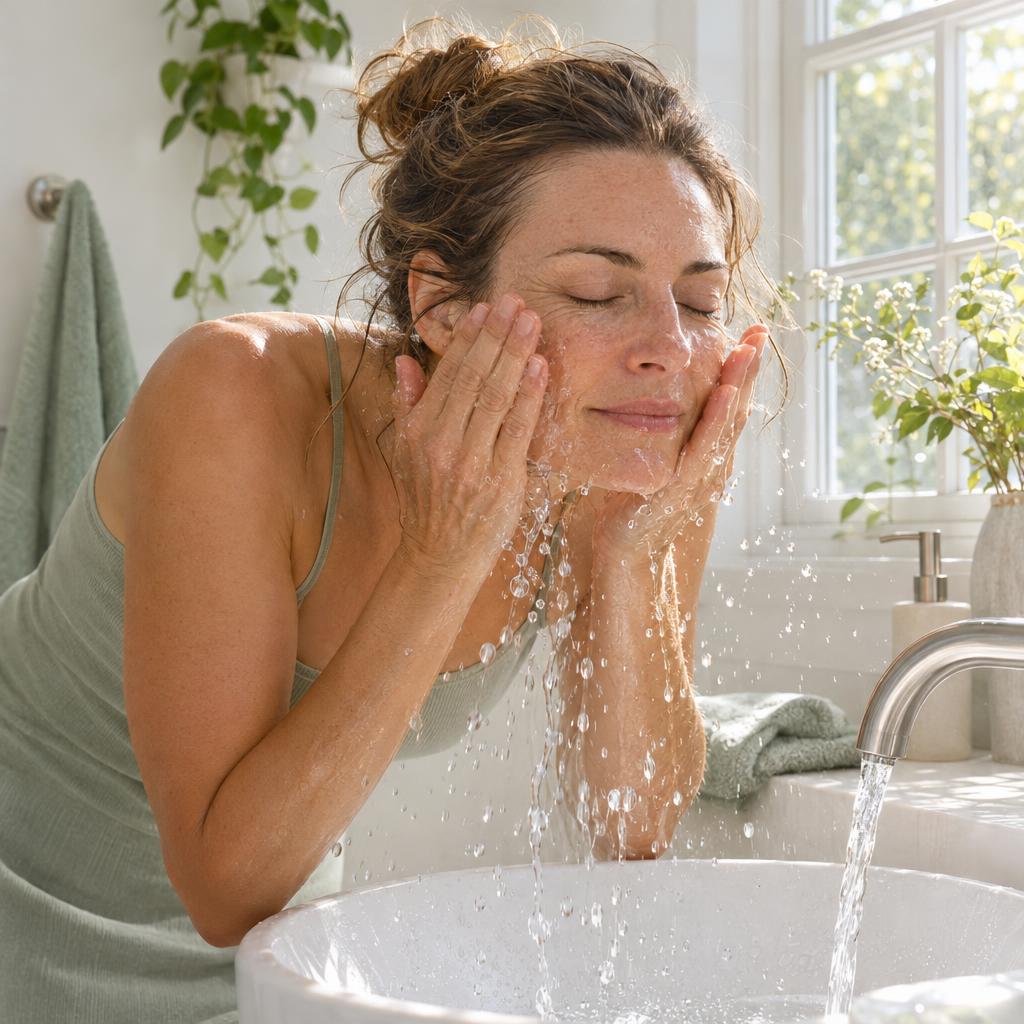
Place my orderIt is 7.10. You have just washed your face, there is a towel in one hand and your phone buzzing in the other, and on the shelf sits a half-full bottle of toner that has been waiting there for months. Yesterday I got this message: “Diana, does toner actually do anything or can I skip it?”. It does, it takes thirty seconds and it is the step that makes the most of the moment right after water. Here is how I would use it tomorrow morning.
What does toner do? The short answer
Your skin is slightly acidic. Left alone it sits at around pH 4.7, and below 5 it stays better hydrated with a more even surface.1 At that pH the enzymes that make ceramides, the mortar holding together the cells of the outermost layer, work happily.2
Tap water, on the other hand, tends to sit around pH 8. One team measured the skin of 330 people and saw that, after washing, pH rises and can take up to six hours to settle back where it belongs.1 That is where toner comes in: an alcohol-free one with a skin-friendly pH helps your skin recover its acidity right after water, gives it back moisture and leaves it ready for serum. That is its job. Thirty seconds, morning and night.

Seven tips for using toner every morning
1. Use it within a minute of cleansing
Pat your skin with the towel without drying it completely, and apply toner straight away. Products with a pH between 4 and 5 help skin keep its acidity after washing,3 and when that acidic pH is looked after consistently, it shows: with a pH 4 cream used for four weeks, skin was better hydrated and the barrier better organised.4 The usual mistake is to wash, get dressed, make coffee and remember the toner twenty minutes later.
2. Choose an alcohol-free toner
What your skin wants after water is more water. At high concentrations, ethanol reduces skin hydration5 and disturbs the order of the barrier lipids,6 so for something you do twice a day, alcohol-free is the natural choice. On the label, check that alcohol or alcohol denat. does not appear among the first ingredients. Fatty alcohols, such as cetyl alcohol or cetearyl alcohol, are a different family: waxy and softening.
3. Look for humectants on the list
A toner is, above all, water with ingredients that hold on to it. Glycerin is one of the best known: it supports hydration of the outer layer and its barrier function.7 If you see it in the INCI, that is a good sign.
4. Press, don't rub
With your hands, five or six drops in the hollow of your palm, then press onto forehead, cheeks, chin and neck. With a spray, two or three pumps a hand's width from your face, eyes closed, then press in with your palms. With a reusable cotton pad, soak it well and glide it without dragging. Cleansing is already done: here you are just giving water.
5. Don't dry it off or wait for it to evaporate
That moisture is for your serum. A humectant serum on damp skin has water to hold on to, so as soon as the toner is spread, move on to the next step.
6. Choose yours by how your skin feels today
If you feel tightness, redness or reactive skin, go for calm. If you get shine on your T-zone or tend to break out, go for pure. If your skin changes with the seasons, you can have both and alternate. And if your skin is reactive, test any new product for three or four nights on the side of your neck before using it on your face.
7. Look after it for what it is: a fresh product
Lid on, away from the radiator and the window, and use it before the date on the pack. Actives lose strength with air, light and time, and a freshly made toner reaches your skin with everything it promises. Used morning and night, it won't sit forgotten on the shelf.
FRESH toner calm, the alcohol-free toner from my fresh cosmetics shop
It is the one I use and the one I recommend when skin feels reactive, tight or flushed. It is alcohol-free, with a skin-friendly pH and plant-based ingredients, and like the whole FRESH range it is made in small batches, with a short use-by date and without synthetic preservatives: it reaches your skin freshly made, like the food you keep in the fridge (I explain it in fresh cosmetics without preservatives). If your skin is combination or oily, its sibling is FRESH toner pure, also alcohol-free.
- ✓ Alcohol-free: adds water at just the right moment
- ✓ Skin-friendly pH (the exact value is on the shop's product page)
- ✓ Fresh cosmetics: small batches, without synthetic preservatives
- ✓ Code DIANAMARTINEZ: €20 off your first order of €50 or more
Transparency: I am an independent RINGANA partner and I earn a commission if you buy through my shop. I only recommend what I use. You will find the ingredients of each toner on its product page in the shop.
How toner fits into your four steps
Toner is step 2 of the 4-step routine. Here is a real morning, from 7.10 to 7.14. At night, the same, without the sunscreen.
Step 1. Cleanser: off with the night
Lukewarm water and a chickpea-sized amount of FRESH cleanser, a gentle sulphate-free cleanser. Thirty seconds of massage with your fingertips, rinse and pat dry with the towel. The gentler this step, the easier the next one; if you want to fine-tune it, there are more ideas in sulphate-free cleanser and double cleansing.
Step 2. Toner: pH back where it belongs
With your face still damp, toner pressed in with your palms. FRESH toner calm if your skin is sensitive or dry; FRESH toner pure if it is combination or oily. It balances pH after water and leaves the surface damp.
Step 3. Serum: the deep work
Serum works from deep within the skin, helping cells renew and keep a youthful look. On skin still damp from the toner, two or three drops of FRESH hydro serum, a humectant serum; if you want anti-ageing care, FRESH anti-wrinkle serum. Spread it and move on to the last step without waiting.
Step 4. Cream: hydrate and seal
Cream hydrates and seals in what the three previous steps have done: light if your skin is oily, medium if it is normal or combination, rich if it is dry. All three contain ceramides and natural moisturising factor, with no fragrance. Sunscreen on top, and off to breakfast.
Toner calm or pure? Cream light, medium or rich?
The answer depends on how your skin is right now. I have put together a free test to tell you which cleanser, toner, serum and cream are yours. Your result arrives by email with my personal recommendation.
Take the free test
Questions I get asked
- “Does toner close your pores?” Pores have no muscle to open or close them. What you do feel is fresh, damp skin with its pH where it belongs, and that smooth, toned feeling comes from there.
- “If it doesn't tingle, is it doing anything?” Yes. A good toner feels like freshness and water, nothing more. If a product stings every time you use it, your skin is asking you for a different one.
- “My skin is oily, shouldn't I use something that dries it out?” Oiliness depends mainly on hormones, not on what you put on top. Oily skin loves a light alcohol-free toner, like pure, and a light cream that keeps it comfortable.
- “What if I'm in a rush one day?” One day is fine. But it takes thirty seconds, and if you need to cut something, cut the time in front of the mirror, not the step.
When this stops being skincare (and when to write to me)
As a healthcare professional, I know that sometimes what looks like a routine problem is something else. Book an appointment with your dermatologist or GP if your face stays red, with heat or visible little veins; if any product, water included, stings straight away again and again; if the day after trying something new you get red, itchy, flaky patches; if your eyelids swell or hives appear (that same day); if you have areas that don't improve in a week or two, or cracks that bleed; or if acne leaves marks or painful nodules. I wrote about that line with acne in adult acne in women.
For routine questions (which toner, in what order, why your skin feels tight after washing), start with the free test or write to me from my page. I answer personally.
In short
Your skin is happiest at an acidic pH, and tap water raises it for hours every time you wash. Toner is step 2 of the 4 steps: within a minute of cleansing, alcohol-free, pressed in with your palms on damp skin and left undried, so your serum has water to hold on to. Calm if your skin is sensitive or dry, pure if it is combination or oily. Lid on, away from heat and before the date. Thirty seconds, morning and night.
Your toner tomorrow morning: fresh cosmetics, alcohol-free and on damp skin
In my shop you will find both alcohol-free toners, calm for sensitive, dry skin and pure for combination and oily skin, plus the other three steps of the routine. With the code DIANAMARTINEZ you get €20 off your first order of €50 or more. And if you can't decide between them, the test sorts it out in two minutes.
Get the tip of the week in your inbox
Simple ideas to look after your skin and look your best, that fit into your day. One email a week; unsubscribe whenever you like.
By subscribing you accept the privacy policy. The list is managed with MailerLite.
References and evidence
- Lambers H, Piessens S, Bloem A, Pronk H, Finkel P. Natural skin surface pH is on average below 5, which is beneficial for its resident flora. Int J Cosmet Sci. 2006;28(5):359-370. https://pubmed.ncbi.nlm.nih.gov/18489300/
What it shows: measurements in 330 people, funded by a hygiene manufacturer; natural pH around 4.7, tap water raises it for hours and below 5 the barrier works better. - Proksch E. pH in nature, humans and skin. J Dermatol. 2018;45(9):1044-1052. https://pubmed.ncbi.nlm.nih.gov/29863755/
What it shows: narrative review; pH range of 4.1 to 5.8, and the role of acidic pH in ceramide enzymes and in shedding. - Blaak J, Staib P. The relation of pH and skin cleansing. Curr Probl Dermatol. 2018;54:132-142. https://pubmed.ncbi.nlm.nih.gov/30130782/
What it shows: review; washing or rinsing with water raises pH for hours, and products at pH 4-5 help maintain physiological acidity. - Kilic A, Masur C, Reich H, Knie U, Dähnhardt D, Dähnhardt-Pfeiffer S, Abels C. Skin acidification with a water-in-oil emulsion (pH 4) restores disrupted epidermal barrier and improves structure of lipid lamellae in the elderly. J Dermatol. 2019;46(6):457-465. https://pubmed.ncbi.nlm.nih.gov/31106905/
What it shows: 4-week randomised trial in 20 older people, funded by the manufacturer; the pH 4 emulsion improved hydration, lipid lamellae and resistance to a rise in pH. Done with a cream, not a toner. - Löffler H, Kampf G, Schmermund D, Maibach HI. How irritant is alcohol? Br J Dermatol. 2007;157(1):74-81. https://pubmed.ncbi.nlm.nih.gov/17578437/
What it shows: study in 15 volunteers with 60-100% ethanol (hand gels); it reduces hydration without increasing water loss or redness. Concentrations far higher than in a toner. - Kwak S, Brief E, Langlais D, Kitson N, Lafleur M, Thewalt J. Ethanol perturbs lipid organization in models of stratum corneum membranes: an investigation combining differential scanning calorimetry, infrared and 2H NMR spectroscopy. Biochim Biophys Acta. 2012;1818(5):1410-1419. https://pubmed.ncbi.nlm.nih.gov/22366204/
What it shows: lab study in model membranes, no people involved; ethanol disorganises barrier lipids at low concentrations and extracts them at moderate ones. - Fluhr JW, Darlenski R, Surber C. Glycerol and the skin: holistic approach to its origin and functions. Br J Dermatol. 2008;159(1):23-34. https://pubmed.ncbi.nlm.nih.gov/18510666/
What it shows: review on glycerin; it improves hydration, barrier function and the mechanical properties of skin. Data mostly from creams.
Order from my shop
The four steps of the routine and everything I use every day, shipped by RINGANA. With the code DIANAMARTINEZ you get €20 off your first order of €50 or more. Not sure what to choose? Take the free test first.
Frequently asked questions
What does facial toner do?+
It helps your skin recover its acidic pH right after washing, because tap water raises it for hours. It also gives back moisture and leaves skin ready so your serum has water to hold on to. It is step 2 of the routine: after cleanser and before serum, morning and night, in about thirty seconds.
How do you apply facial toner?+
Within a minute of cleansing, while your skin is still damp. Put five or six drops in the hollow of your palm and press onto forehead, cheeks, chin and neck, or use two or three pumps if it is a spray. With a reusable cotton pad, glide it without dragging. Don't rinse it off or dry it: go straight on to your serum.
Why choose an alcohol-free toner?+
Because after water, what your skin wants is more water. At high concentrations, ethanol reduces hydration and disturbs the order of the barrier lipids, so for something you do twice a day, alcohol-free is the natural choice. On the label, check that alcohol or alcohol denat. does not appear among the first ingredients.
Which toner should I choose for my skin type?+
If you feel tightness, redness or reactive skin, FRESH toner calm. If you get shine on your T-zone or tend to break out, FRESH toner pure. Both are alcohol-free. If your skin changes with the seasons, you can alternate them, and if you are unsure, the free test tells you which one is yours in two minutes.
Does toner close your pores?+
Pores have no muscle to open or close them. What you feel with a good toner is fresh, damp skin with its pH where it belongs, and that is where the smooth, toned feeling comes from. Use it to prepare your skin for serum and cream, pressing it in with your palms on freshly washed skin.
#facial toner#alcohol-free toner#how to use toner#skin ph#morning routine#4-step routine#fresh cosmetics