Home › Blog › Skin through the seasons
Skin after summer: how to recover it in 4 simple steps

Already know what you need? Order from my RINGANA shop. With the code DIANAMARTINEZ, €20 off your first order of €50 or more.
Place my orderThe first Monday of September, 7:10 in the morning. You switch on the bathroom light and the face in the mirror feels tight when you smile, shines on the forehead and is rough across the cheeks. And on your cheekbone there is a dark spot you would swear was not there in June. Good news: skin after summer bounces back, and what helps most fits into ten minutes a day. Here is what I would do from tomorrow, in order.
What happens to your skin in September
The August sun leaves two things behind. First, a thicker outer layer, which the skin builds to defend itself and which dims the glow of your face. Second, a barrier with loose joints: the “mortar” of lipids that holds the cells together suffers, and water escapes faster than it comes in1. That is why it feels tight and shiny at the same time, whether your skin is dry or oily.
Dark spots are a different story. Some are the traces of many summers; others, the shadow of a spot or an insect bite. All of them respond better to patience and sunscreen than to haste.

Seven tips to recover your skin after summer
1. For the first three weeks, water before exfoliation
It is tempting to reach for a scrub and peel August off in a week. Give your skin two or three weeks of hydration and protection first. Skin with a weakened barrier loves calm, and on darker skin rubbing can leave exactly the shadow you wanted to fade. Set a reminder on your phone for the day the scrub comes out of the drawer.
2. Serum on skin that is still damp
After the toner, do not wait for it to dry. Two or three drops of a hydrating serum on skin that is still fresh, pressed in with your palms, not dragged. Humectants such as glycerin attract water and hold it in the outer layer, improving hydration and barrier function2. On damp skin they have more water to catch. A common mistake: five layers of product. One good layer is enough.
3. Cream to suit how your skin is today
Not how it was in June: if it feels tight now, even if you are usually shiny, it may want a slightly richer texture for a few weeks. Use a hazelnut-sized amount, start with your cheeks, which feel tightest, and finish with your forehead. If the tightness is back by mid-morning, the texture is too light for you.
4. Sunscreen every morning, in October too
I know you want to put it away with your flip-flops. In Australia, 903 adults were followed for four and a half years: those who applied sunscreen every morning showed 24% fewer signs of ageing than those who used it when they remembered3. How much: two finger-lengths of product for face and neck, always as the last step of your morning. Across much of Spain the UV index stays moderate well into autumn; you can check it every day on the AEMET website.
5. If you get dark spots easily, tinted sunscreen
Visible light, the light you can see, also darkens deeper skin tones, and for longer than some ultraviolet light does4. Tinted sunscreens contain iron oxides, which hold it back5. If your sunscreen is untinted, a foundation with iron oxides on top does the same job. Check the ingredient list: they appear as “iron oxides” or “CI 77491”.
6. Antioxidants, once your skin stops feeling tight
Vitamin C and its companions are the serum's second job, and they add to your sunscreen without taking its place6. Bring them in once your skin feels comfortable, two or three mornings a week at first and then daily. If it stings, take a step back. I explain how to choose it in my article on vitamin C for your face.
7. From week four, gentle exfoliation
Now is the time. If your skin still feels rough, an exfoliating mask every ten to fifteen days, in the evening, on clean dry skin, without rubbing. Rinse it off with lukewarm water and follow with toner, serum and cream. That night, nothing else: no acids, no retinoids.
FRESH hydro serum, the hydrating serum from my fresh cosmetics shop
After summer, the first thing your skin asks for is water. This is the hydrating serum I use in September: a few drops on skin still damp from the toner, and the cream seals it in. Fresh cosmetics: small batches, plant-based ingredients, without synthetic preservatives, a skin-friendly pH and a short use-by date, so it reaches your skin freshly made and with everything it promises. For the exact ingredients, check the product page in the shop.
- ✓ Hydrating serum: brings water to skin that comes back from summer feeling tight
- ✓ Fresh cosmetics without synthetic preservatives, made in small batches
- ✓ Suits dry, combination and oily skin: tightness does not discriminate (see the product page)
- ✓ Code DIANAMARTINEZ: €20 off your first order of €50 or more
Transparency: I am an independent RINGANA partner and I earn a commission if you buy through my shop. I only recommend what I use.
How it fits into your four steps: a September morning
My routine has four steps, morning and evening: cleanser, toner, serum and cream. You will find them explained in the 4-step guide. This is how they look on any September morning, in under five minutes.
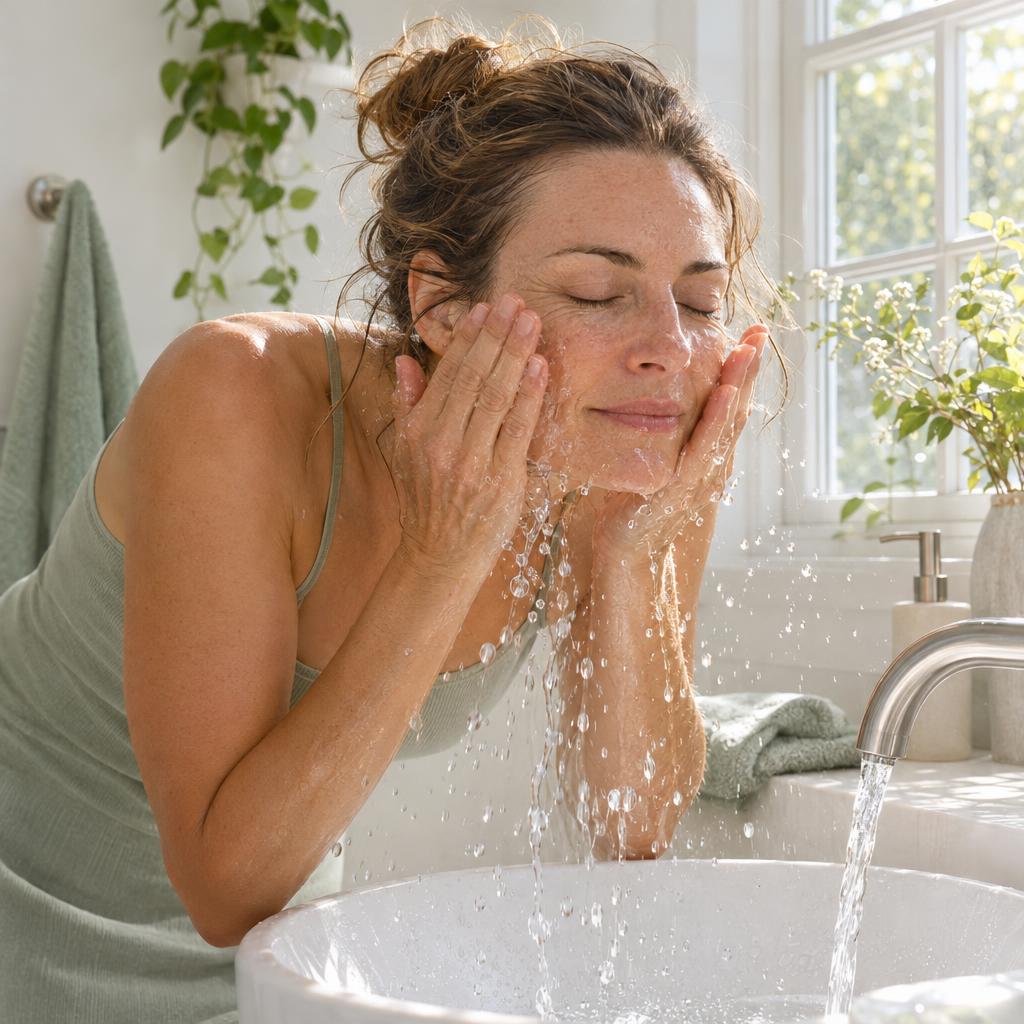
Step 1. Cleanser: wash the night away
Lukewarm water, never hot, and a walnut-sized amount of FRESH cleanser, a gentle sulphate-free cleanser that lifts the night's grime without leaving your face tight. Thirty seconds of massage, then rinse. In the evening, if you wear water-resistant sunscreen or make-up, a double cleanse works well; I explain it in my article on sulphate-free cleansers.
Step 2. Toner: skin back to its pH
Tap water leaves your skin outside its slightly acidic pH, and toner brings it back where it belongs and leaves it damp for the serum. If it is sensitive or red, FRESH toner calm; if it is shiny and prone to spots, FRESH toner pure. Both are alcohol-free, something thirsty skin appreciates. More details in what facial toner is for.
Step 3. Serum: the deep work
Serum works from deep within the skin: it helps cells renew and keep a youthful look. In September, water first: FRESH hydro serum on skin still damp from the toner. Once it stops feeling tight, add your antioxidant in the morning. And FRESH exfoliating mask waits its turn until week four, in the evening and before the toner.
Step 4. Cream: hydrate and seal
Cream hydrates and seals in everything before it. Choose by how your skin is today: shiny or prone to spots, FRESH cream light; normal or combination, medium; dry and tight, rich. All three combine ceramides with natural moisturising factor and are fragrance-free, just what skin returning sensitive appreciates. On top, sunscreen: I wear FRESH sunscreen face; its SPF and filters are on the product page.
How has your skin come back from summer, and what does it need at each step?
Tight, sensitive, shiny, with dark spots: we do not all come back the same. With my free test you will know which cleanser, toner, serum and cream your skin needs right now. Your result arrives by email with my recommendation.
Take the free test
Questions I get asked
- “I am already tanned, do I still need sunscreen?” Yes. A tan is the defence of skin that has already had sun, and daily sunscreen saves it work.
- “How long until my skin feels better?” Tightness usually eases after one or two weeks of a consistent routine. Glow and texture take about a month, which is how long the skin needs to renew its outer layer.
- “Will the spot on my cheekbone go away on its own?” If it is the shadow of a spot or an insect bite, it usually fades within a few months if you protect it from the sun. If it is a classic sunspot, sunscreen stops it getting darker; to lighten it, your best bet is to have your dermatologist look at it.
When this stops being skincare (and when to write to me)
As a healthcare professional, I suggest a September ritual: since you are looking at your face more closely, take a look at your moles too. Skincare supports tight skin and helps your tone look more even; what it does not do is diagnose. Dermatologists use the ABCDE rule7, and I would ask you to book an appointment with a dermatologist or your GP if a mole:
- A: is asymmetrical, one half does not match the other.
- B: has irregular or blurred borders.
- C: mixes several colours.
- D: is larger than 6 mm.
- E: changes in size, shape or colour, itches, bleeds or crusts over. This is the sign that matters most.
Also worth an appointment: a new, firm lump that grows over weeks, even if it is skin-coloured8; a little sore that has not healed in three or four weeks; and a rough, scaly patch that does not go away. And if you have large, symmetrical patches on your forehead, cheekbones or upper lip, have your dermatologist assess them; your routine and your sunscreen will be the support.
For everything else (tight skin, dull skin, shine, choosing between light or rich cream), I am right here. Take the free test and my recommendation arrives by email; if you would rather tell me about your skin, my page shows you how to write to me.
In short
In September your skin asks for water and calm. Three weeks of a gentle cleanser, an alcohol-free toner, a hydrating serum on damp skin and a cream to suit how your skin is today, with sunscreen every morning, in autumn too, and tinted if you get dark spots. Once it stops feeling tight, add an antioxidant; from week four, a gentle exfoliation every ten to fifteen days. And once a year, while you are looking in the mirror, check your moles: if one changes, see a dermatologist.
Recover your skin after summer with fresh cosmetics
My shop has all four steps for September: a sulphate-free cleanser, an alcohol-free toner, a hydrating serum and a cream for your skin type, plus a facial sunscreen. With the code DIANAMARTINEZ you get €20 off your first order of €50 or more. And if you are not sure where to start, start with the test.
Get the tip of the week in your inbox
Simple ideas to look after your skin and look your best, that fit into your day. One email a week; unsubscribe whenever you like.
By subscribing you accept the privacy policy. The list is managed with MailerLite.
References and evidence
- Biniek K, Levi K, Dauskardt RH. Solar UV radiation reduces the barrier function of human skin. Proc Natl Acad Sci U S A. 2012;109(42):17111-17116. https://pubmed.ncbi.nlm.nih.gov/23027968/
What it shows: laboratory study on human stratum corneum; UV radiation reduces cohesion between cells and barrier function, which explains the tightness after summer. - Fluhr JW, Darlenski R, Surber C. Glycerol and the skin: holistic approach to its origin and functions. Br J Dermatol. 2008;159(1):23-34. https://pubmed.ncbi.nlm.nih.gov/18510666/
What it shows: review on glycerin; it improves hydration, barrier function and the mechanical properties of the skin. - Hughes MC, Williams GM, Baker P, Green AC. Sunscreen and prevention of skin aging: a randomized trial. Ann Intern Med. 2013;158(11):781-790. https://pubmed.ncbi.nlm.nih.gov/23732711/
What it shows: randomised trial of 903 adults over 4.5 years in Queensland; daily sunscreen reduced signs of photoageing by 24% compared with use as needed. The best randomised evidence available, with limited statistical power. - Mahmoud BH, Ruvolo E, Hexsel CL, Liu Y, Owen MR, Kollias N, Lim HW, Hamzavi IH. Impact of long-wavelength UVA and visible light on melanocompetent skin. J Invest Dermatol. 2010;130(8):2092-2097. https://pubmed.ncbi.nlm.nih.gov/20410914/
What it shows: experimental study with 20 volunteers of skin types IV to VI and a few of type II; visible light caused more and longer-lasting pigmentation than long-wavelength UVA in darker skin, and none in fair skin. - Lyons AB, Trullas C, Kohli I, Hamzavi IH, Lim HW. Photoprotection beyond ultraviolet radiation: a review of tinted sunscreens. J Am Acad Dermatol. 2021;84(5):1393-1397. https://pubmed.ncbi.nlm.nih.gov/32335182/
What it shows: narrative review, with one co-author linked to a sunscreen manufacturer; the iron oxides in tinted sunscreens protect against visible light, useful in melasma and post-inflammatory hyperpigmentation. - Murray JC, Burch JA, Streilein RD, Iannacchione MA, Hall RP, Pinnell SR. A topical antioxidant solution containing vitamins C and E stabilized by ferulic acid provides protection for human skin against damage caused by ultraviolet irradiation. J Am Acad Dermatol. 2008;59(3):418-425. https://pubmed.ncbi.nlm.nih.gov/18603326/
What it shows: small trial on irradiated human skin, funded by the formula's manufacturer; 15% vitamin C + 1% vitamin E + 0.5% ferulic acid reduced redness and DNA mutations. Evidence for that specific formula, as a complement to sunscreen. - Abbasi NR, Shaw HM, Rigel DS, Friedman RJ, McCarthy WH, Osman I, Kopf AW, Polsky D. Early diagnosis of cutaneous melanoma: revisiting the ABCD criteria. JAMA. 2004;292(22):2771-2776. https://pubmed.ncbi.nlm.nih.gov/15585738/
What it shows: review in JAMA that updates the ABCD criteria for melanoma and adds E for evolution. - Kelly JW, Chamberlain AJ, Staples MP, McAvoy B. Nodular melanoma. No longer as simple as ABC. Aust Fam Physician. 2003;32(9):706-709. https://pubmed.ncbi.nlm.nih.gov/14524207/
What it shows: clinical review article; nodular melanoma does not follow the ABCD rule and presents as a firm, fast-growing lump.
Order from my shop
The four steps of the routine and everything I use every day, shipped by RINGANA. With the code DIANAMARTINEZ you get €20 off your first order of €50 or more. Not sure what to choose? Take the free test first.
Frequently asked questions
How do I recover tight skin after summer?+
With water and consistency. Cleanse with a gentle cleanser, apply an alcohol-free toner and, without waiting for it to dry, two or three drops of hydrating serum pressed in with your palms. Seal it in with a cream to suit how your skin is today, even if that means a slightly richer one than in June. Tightness usually eases within one or two weeks.
When can I exfoliate after summer?+
From week three or four, once your skin feels comfortable. Until then, focus on hydrating and protecting. After that, if it still feels rough, use a gentle exfoliating mask every ten to fifteen days, in the evening, on clean dry skin and without rubbing. That night, do not combine it with acids or retinoids, and finish with toner, serum and cream.
Do I need to keep wearing sunscreen in autumn?+
Yes, every morning and as the last step of your routine. Across much of Spain the UV index stays moderate well into autumn, and daily use is what makes the difference to how your skin looks over the years. Use about two finger-lengths of product for face and neck, and choose a tinted one if you get dark spots.
Will the dark spot I got this summer go away on its own?+
If it is the shadow of a spot, a burn or an insect bite, it usually fades within a few months if you protect it from the sun every day. If it is a classic sunspot, sunscreen stops it getting darker, and to lighten it your best bet is to have your dermatologist assess it. Meanwhile, a tinted sunscreen with iron oxides helps.
When should I start vitamin C after summer?+
Once your skin stops feeling tight, usually after two or three weeks of hydrating. Start with two or three mornings a week, after the toner and before the cream, and build up to daily use if your skin feels comfortable. If it stings, take a step back. Always with sunscreen on top: they add up, one does not replace the other.
When should I see a dermatologist about a mole or a mark?+
If a mole changes in size, shape or colour, itches, bleeds or crusts over, or if it is asymmetrical, has irregular borders, several colours or is larger than 6 mm. Also for a new, firm lump that grows over weeks, a little sore that has not healed in a month or a rough, scaly patch. Book an appointment with a dermatologist or your GP.
#skin after summer#dehydrated skin#dark spots#sunscreen#hydrating serum#exfoliation#4-step routine